Sunday, January 5, 2014

Revision and Reflection

     Earlier this week I submitted the first draft of the written component for my M.Ed. portfolio.  The title of the piece is, "A Rationale for using Technology in Project Based Learning".  I must admit that in the week that my advisor had it, I kept my Lakehead University email window open on my computer.  I was both eager and anxious about getting the feedback that I knew would be coming. While I know that the work is well received, somewhere, in the back of any learners' mind, I believe that there is the hope that the work will be done, finished, completed.  I ran through a wide range of emotions while I attempted to figure out, or actually guess, at what the feedback might be.  I wondered what the comments would be, what areas would be well done, and in particular what areas I still need to shore up.
     It continues to amaze me at how important the PBL essential of Revision and Reflection is to learning.  It would have been awesome and a relief to have had no suggestions for revision but then again this is the first draft that I have submitted.  It is also somewhat refreshing to not receive a mark but to only have comments.  In an earlier course with Dr. Paul Berger, of Lakehead University, called Critical Pedagogy, I read a piece about assessment by H. Kirschenbaum (1971) titled
 Wad-Ja-Get? The grading game in American education - referring to how often learners simply want to know their "final mark".
 The final mark, however, really can't enhance my learning or make the final product any better. This reading selection was eye opening for me and has shaped the methods that I use for assessment.  I want to provide my students with rich feedback, praise, guidance and suggestions for improvement.  I also want my students to desire these same things and to create a culture of learners who work together to build and honour each other; I want my students to not be so concerned about their mark because they have constructed it and been a part of shaping it.
     The feedback that I have just received on my first draft is rich and valuable - I will be making some changes! One great great responsibility that I have, as a learner and the owner of the work regarding feedback, is that I have the choice to implement none, some, or all of the feedback.  However, if I truly desire to to learn and, to produce better work, then I need to see each comment, idea, and suggestion as a stepping stone to these desires. While the comments initially look intimidating, and overwhelming, the more I read them and piece them together, the more I can see how valuable they are and how they are necessary.
   The Ontario Ministry of Education's document titled  "Growing Success" does a great job of explaining its three levels of assessment - For, As, and Of - see page 31 for a table that summarizes them.  Each level of assessment plays a key role in shaping the learning, the learner and the educator.
   As I go back to school tomorrow after the Christmas break, I wonder if I have sufficiently provided my student with strategies to provide and accept feedback? More importantly, I wonder if I have blessed them and honoured them through the feedback that I have provided?  I also wonder if the revisions that my students have made have been completed out of a sense of duty or if these revisions have been completed joyfully?
     I am almost done - I was excited to read in the email accompanying the feedback that "maybe 2 more edits to go depending on how you wish to deal with the remaining sections of the work." and then it will be finished.  


Kirschenbaum, H., Napier, R., & Simon, S. (1971). Wad-Ja-Get? The grading game in American education. New York: Hart Publishing.

Sunday, December 15, 2013

Perfect is the Enemy of Done

Two big things are occurring this week in my educational path - my students are doing their presentations of learning as they are wrapping up their Communication Technology Projects and I have just dropped off the written component of my Masters of Education potfolio to my good friend Eric for some edits.  These two events strike me as being quite similar as they both have a "finality" type of feel to them.  I hope that I am as successful with my written work as my students were with their presentations.  In October, while attending the ECOO (Educational Computing Organization of Ontario - if you haven't been I strongly encourage you to go! It ranks right up there with PBLWorld for being my favourite conference), I had the chance to attend many workshops and listen to excellent keynote speakers.  I cannot recall which presenter it was, but one of them used the line "Perfect is the Enemy of Done".
I have since used this line a number of times with my students as they sometimes get stuck on an idea, or more likely they develop an idea that is too grand to complete.  On a more personal note I have used this line on myself as a way to motivate myself to complete my work. Being in the role of a student concurrently while teaching has provided an interesting perspective on education.  I notice that I get stuck on similar things that my students also get stuck on.  There have been many changes from the initial stages of what my final Master's Project might look to what it actually is - Using Technology to Support PBL.
   Another similarity with a number of my students is that we sometimes struggle with getting things done - some of us for different reasons, but lately I am believing that we can always see ways to improve our work.  After each of my students presented their project this past week, the rest of the class did a quick "I like..., I wonder..." protocol.  In this protocol we could specifically state the things that we appreciated about their work and ask questions about how they completed things or even provide further ideas to make their project better.  On my paper, which I will post when it has been completed, I think that I could keep making edits and always find ways to improve it.  This does not mean that I don't like my work, rather, it means that our thoughts and learning continually grow and are dynamic.  However, at some time I just need to be done; I need to say that this work is finished so I can move on.  My work will never be perfect- it can't be perfect, there is always more revision and reflection that I can do.  Throughout my portfolio, I have been stuck on trying to make it perfect, but I have now realized that it is time to be done.  I know that there will be edits yet to do on my work, but it is time that I put my energy into other things, things that have been neglected, pushed aside, and people that have "supportingly" and lovingly given me permission to take up their time and focus on myself.  This change will happen really soon! It is feeling good to be done - well, almost done!

Sunday, November 24, 2013

Can you add some technology to that, please?

My grade 10 Communication Technology class is about 3 weeks into our project.  I am excited and anxious about this project as it is the first time that I have really stepped back and let the students develop their projects .  The class had to create a project overview sheet to help them plan.  And while it has been difficult and a bit unnerving as I share control of the activities and learning that is going on in my class, I find myself continually asking my class, "How can I help?", as I want my students to be successful as they step into their projects.  My part in their learning experience now is to provide support. Aside from leaving the room so I stop bugging them, some ways that I am supporting them are by providing instruction and suggestions that can help them manage their projects.  The students have the choice of using Scrumy or Linoit  to use for their project management.  Both of these resources can be shared with me, allowing me to peek in on their progress from time to time.  These tools also bring in a level of accountability for the students.  They can no longer say, "I've got it all right up here." as they point to their heads.  The planning stages of their project is crucial to its success.

Earlier, the class did a Gallery Walk protocol. All students/groups completed their project overview, taped them to the wall and other students, and some other teachers, provided feedback on the project under the confines of "be positive, be helpful, be specific." On the project overview sheet, students need to intentionally consider who their audience would be. Many of the projects involve the creation of videos, so naturally, the response by many was Youtube.  After some discussion with our classroom guest teachers, it was evident that Youtube was not an audience but rather a tool to be used to reach an audience.  This led to a great opportunity for a mini lesson, Four Square Protocol, a discussion about the purpose of an audience, technology tools that can be used to communicate to an audience and how an audience can shape the actual project.  The conclusions that the class have reached mirror some of the conclusions that I am drawing from my own research; it is important to use technology for successful projects and it is also important to understand that technology should not be what is driving our projects.  Instead, technology should be tools that we use create artifacts and to convey our message.

For those of you who have been following my journey of completing my M.Ed. project on developing a rationale for using technology in PBL and the creation of video tutorials to accompany the rationale, I am please to say that I am in the final stages of my rough draft and have created several videos.  If things go according to schedule, I hope to be completed in the next month or shortly after.

Sunday, October 20, 2013

Revision and Reflection are Allowing me to Learn!

I have been working on some of the video tutorials for my portfolio.  I am enjoying making the videos about technology and how technology can, and I would say needs to be used to, support Project Based Learning.  The creation of the videos could not be possible without the readings, research and thought that I have put into the topic of "how can technology support PBL," As I have been making the videos, a lot of revision and reflection has taken place.  I would sometimes revise a script, edit a video, recapture part of my screen shots and occasionally start all over.  I have so far created three video tutorials for this project, with the rest coming pretty soon.  I am enjoy the making of the videos because I am passionate about discovering how technology works best in education and I enjoy providing resources to help other teachers. The creation of the videos is the learning process in that I can now really put theory to practice in the creation of artifacts for an audience.

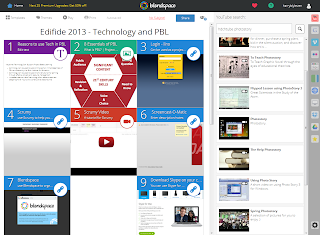
For the videos, I have been attempting to find out what tools and resources to include in the videos and which ones to not include.  I am trying to find resources that can be used by both the teacher and the student.  I am also trying to include resources that have multiple uses and tie into several of the 8 Essentials of PBL.  My favourite online tool right now has to be Blendspace.  Here is an example of a Blendspace that I have made for a workshop I will be giving on "Using Technology to Support PBL" at the Edifide Teachers Convention in a couple of days. Blendspace helps the teacher to manage the information and resources that students will need as they work on a project.  With its grid set-up, Blendspace organizes the online learning space.  To create a Blendspace the owner of the space quickly and easily drags and drops in resources from YouTube, Google, Vimeo, Flickr, EduCreations, Dropbox, Google Drive, bookmarks for links, or they can upload their own resources and multimedia files.  For the student, Blendspace can help them organize the videos, websites and resources that they are working on - it can be a digital notebook.  Blendspace can also be used as a digital portfolio tool allowing students to post their findings, creations and it can be easily shared with others.


While I am currently working at completing both the written portion of my Masters Portfolio and the video tutorials, I am finding that the two components really drive each other.  The theory aspect of having a rationale for using technology provides a necessary grounding that the foundation of the practical videos need.  

I am currently in the Revision and Reflection stage of my portfolio.  I must admit that it feels great to be able to say that because if you look at the 8 Essentials of PBL, as modeled by the Buck Institute for Education, in the following diagram, then you can see I am on the home stretch.  One of the challenges that I have recently experienced in my work is that I am looking at each essential separately rather than looking at all of the essentials as a collective process. This has put up some temporary roadblocks for me as I cannot see this topic ever being completed - which has been a really big struggle for me! It is my hope that in the next 3-5 weeks that I can complete my work - even though this area of work will likely never be finished due to its ever changing nature.  

Wednesday, September 11, 2013

A Boy, Constructivism and LEGO!

I have just finish a section of my final project for my M. Ed. degree.  My overall topic is the implementation of technology into a Project Based Learning. The section I am currently working on is about Constructivism. My research is pointing to how teachers who incorporate technology into their teaching practices generally become more constructivist in their pedagogy choice and delivery.  This often leads to teachers adopting an Inquiry Based Learning strategy.  In the school where I currently teach, Hamilton District Christian High, we have been implementing and using  Project Based Learning.

I like this simple definition of Constructivism from Wikipedia:

Constructivism, as a perspective in education, explains how knowledge is constructed in the human being when information comes into contact with existing knowledge that had been developed by experiences. 

As a teacher becomes more familiar with technology and begins to use it more for their own learning, the next step is to ask the same of your students.  The role then is to help students on their journey of learning by providing a safe learning environment, access to resources and a structured environment in which they can learn.

Now permit me a little brag moment about my son who is just entering grade 4.  Like many kids, school is sometimes fun, sometimes awesome and sometimes boring.  So far the start to this school year has been on the sometimes fun side.  
He needs a reason to learn - he wants to know "why this is important". He also loves LEGO - well really, who doesn't?  He normally gets a new set, builds it, plays with it for a while and then just has it for display on a shelf in his room, our family room, our dining room and our living room. 

Recently he has also developed an interest in super hero movies.  He was a bit disappointed to discover that he would not receive every super hero LEGO set just so he could have the characters to play with. He also realized that he had lots of parts from various LEGO characters of sets that he did not wish to keep.  It become his project to construct his own set of custom LEGO Super Heroes.  He did not just want to make random Super Heroes - he wanted to make his "customs" look as close to the real characters as possible.  It is amazing how much research that he did in order to create his "customs".  He would often just grab the iPad, find images (front and back) and YouTube videos of the authentic character, get his Sharpies, and model paint and start customizing his characters.  Throughout the process he would ask for feedback, not just to receive praise but also to make his characters better.  When he would run stuck on an aspect he would consult the experts - more YouTube videos, his LEGO books, his mom (a talented and precise artist) and his Papa (a talented and precise doll house builder with a big paint selection).  

Each character could take a couple of hours or even days as he patiently waited for paint to dry and the next coat or accessory to be placed. Not every first edition was exactly as planned. He would revise or "do over" until he was happy with the product.  Once a character was complete he would again grab the iPad and create a video about the character and the process necessary to make it.  We haven't uploaded the videos yet, he wants to wait until he is all finished but he has allowed me to snap a couple of pictures.


What has been amazing for me, as a father and teacher, to see is that there was a purpose that was driving the learning and that my son was able to learn from drawing on his past experiences, research how to make and create his "customs" and be able to share his results (soon) with others.

Having seen all of this unfold in the last couple of weeks fuels the fire for me to continue to ensure that my students also have a reason to learn. I want to provide them with authentic learning experiences in which they too can construct and shape their learning.

Saturday, August 10, 2013

Overwhelmed, but going in the right direction.

The research stage of a project can be overwhelming.  I will admit that this is the case for me as I am working on the written piece for my Master Portfolio.  The really hard part is just telling myself to start the writing process.
http://scriptcat.files.wordpress.com/2012/03/research1.jpg
I have thoroughly enjoyed finding, reading and taking notes from the many chapters, articles, blogs etc that I have read about Project Based Learning and technology.  As I work towards developing a solid rationale for using tech in PBL, I am also thinking about which technologies and tools that I wish to highlight via video tutorials.  As I move along and develop the rationale and the 4 key points that I will be focusing on (see previous post) I was reminded of the need to organize, synthesize and catalogue my findings thus far.  Just the process of organizing and grouping my findings has really helped to ease the "overwhelming" feeling and knot in my stomach about "getting going" with the writing process.  I like to run (an ankle injury has recently slowed me down, however).
In the winter I run on a treadmill and watch movies on my laptop to pass the time. Last winter, I watched Finding Forrester.
http://haingu.files.wordpress.com/2011/02/r__findingforrester4.jpg
 
The movie is about an author mentoring a teenager who is a gifted writer.  One of my favourite quotes from the movie is "No thinking - that comes later. You must write your first draft with your heart. You rewrite with your head. The first key to writing is... to write, not to think!"
This quote is now reminding me to just get in there and write and to run with it!

Friday, July 19, 2013

Key Reasons to use Tech in PBL


During the last couple of days, I have been doing a lot of reading about Project Based Learning (PBL) and technology. Specifically, I have been reading how technology can and needs to be used to support learning in a PBL model.  The readings do not out-rightly say that PBL needs technology but that using technology to support PBL is needed. As I work on the final project for completing my Master of Education degree, I am attempting to develop a rationale for using technology in PBL.
I currently am leaning towards a number of key reasons for using technology in PBL. One of the fun things about researching is that you start to read a number of articles, blogs, wikis, tweets and posts that provide you with new and unexpected ideas.  The last part of the rationale for why technology should be used in PBL suggests that much teacher growth, professional development and teacher leadership can be fostered and developed in teachers that incorporate technology into their PBL teaching.  While the particulars and supporting research are not yet included, it is these key reasons below that I am currently working with as to why technology should be included in PBL.

Key Reasons for using Technology in PBL

  • while PBL does not need technology per se, technology can support the learner and the learning process.  I believe that each of the Eight Essentials of PBL can and should be supported by technology. One of the products that I will be creating and sharing as part of my Master's project is a series of video tutorials showcasing technology for each of the Essentials with goals of providing educators and learners with tools that permit them to dig deeper into their learning
  • technology allows for effective planning and management of learning projects. Managing projects, getting student feedback and reflections, and providing students a voice and choice is believed to be readily completed through the use of technology and online tools
  • as teachers learn, and in turn use, more technology in their teaching, their teaching often becomes more constructivist in nature - this should lead to better PBL
  • technology supports Growing Success.
    Growing Success is an Assessment and Evaluation Document for the province of Ontario (Canada). The document empowers teachers with much freedom in terms of assessment tools, collections of information (including conversations and observations) and evaluating students. An important part of Growing Success is Assessment for Learning, Assessment as Learning and Assessment of Learning
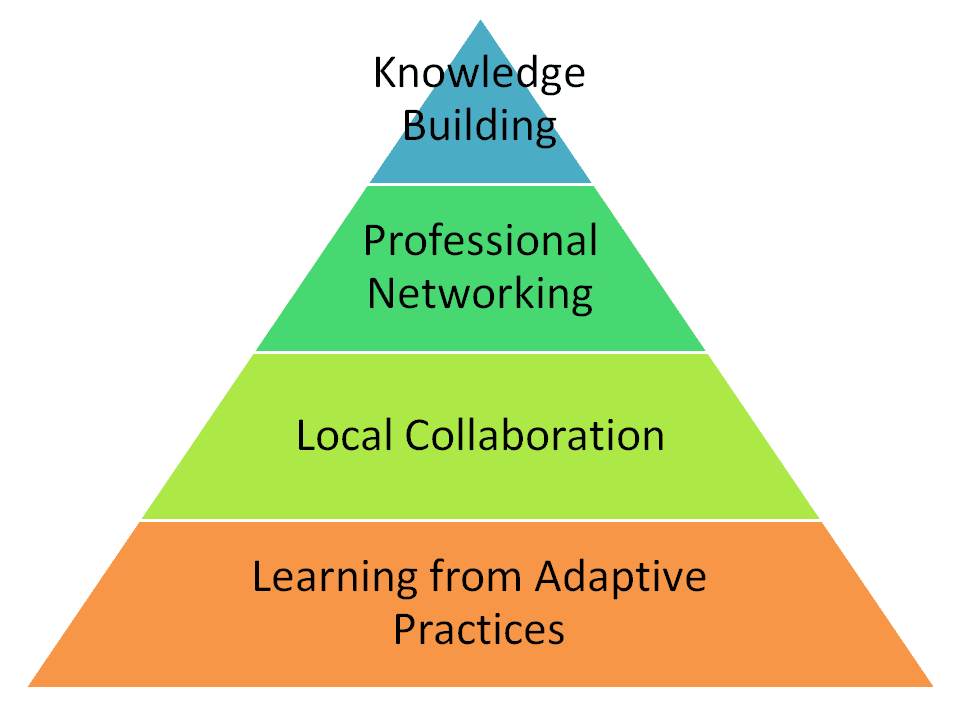
  • using technology in PBL can foster professional growth, professional development and leadership among teachers. Riel and Becker discuss the idea of Teacher Leadership Practices and present their model (pyramid).  This model also is similar to the SAMR model for "Empowering Students with Technology" 

  • Some other important points that I am considering are how technology is supported in my school, how the ISTE Standards can be brought into the PBL - most likely in the 21st Century Learning skills, and the actual density of technology available for learning in our school.

    My steps in the next couple of days are to look more at PBL for 21st Century Success. This book, by Suzie Boss of the BIE, focuses on how the skills of; Critical Thinking, Collaboration, Communication and Creativity are taught, assessed and evaluated in a PBL setting.  My readings are leading towards  technology also playing a key role in this.