Monday, April 7, 2014

The Satisfaction of Being Done


It is hard to believe that I have submitted all of the work for my Masters of Education final portfolio.  It has been a long road. I selected the Portfolio option to complete my final requirement.  For me this option most mirrored Project Based Learning (PBL) which is what most of my work in my studies has been about and it is the pedagogy that I teach with.  


In my work I have developed a rationale for the integration of technology into PBL.  I also have created a how-to video series that supports my 4 rationale points with various examples of technology that can be used in PBL.  The videos can be found on my YouTube Channel http://www.youtube.com/user/technology4pbl

I have used this blog as the reflection component for my portfolio.  This blog has been a spot for me to write my ideas down, and reflect upon my own learning and how this reflection can help further shape my learning.

In my last post I said that I needed to figure out what is next for me.  While there still many regular duties that I have as a teacher and much planning that I have to do as part of the Ontario Christian Teachers Academy (http://teacheracademy.ca/Homepage) , there are more important things to do right now - I get to again be more committed to my family.  They have put up with a lot of "busyness" and I need to give back.  I cannot thank them enough for their support, patience, love and firmness when needed.

I also am in dire need of rest...for a little while.  While I intend to keep being a teacher-learner, I must confess that I do not yet know what this next stage looks like.  I have discovered that I do enjoy leading workshops, and being involved in teacher training (preservice and inservice).

When I started this process,  I told myself that I would learn to play a guitar when I finished.  It is almost time to go shopping!


Sunday, March 23, 2014

Revision and Reflection - revised!

It has been a while since my last post.  January and February were busy months for me - coaching, night classes, marking and teaching.  Working on my Master's portfolio was pushed to the side and I attempted it when time
http://blogs.miracosta.edu/
permitted.  These two months were also a transition time in my high school classes - the end of one semester and the beginning of another.

Over the last 2-3 weeks I have put in more time for my project - A rationale for using technology in Project Based Learning.  I received feedback, had an honest conversation with my advisor and I did lots of revisions.  I am happy to report that there are only a few small edits that need to take place to this version of the paper before it goes to the next advisor for review.

http://upload.wikimedia.org/wikipedia/
I also had a great conversation with a friend of mine.  I told him that I look forward to being complete so that I can become current again in my topic.  What I mean is that most of the articles, posts, and my own work, have not changed much in the last year, as I have focussed on my project.  I have revised and reflected but I have not been able to stay as current as I would like.  Is it possible that revision and reflection can take up too much time at the expense of new knowledge?

I definitely see the value and worth in revising my work and taking the time to reflect upon it but have I lost out on anything?  What valuable findings and conversations have occurred while "I have been out"? I know that there were great tweets, and tweetchats that I missed.  What about some new articles and tech tools that I have missed that others have shared?  I have wrestled with these thoughts for the last couple of months.

I have also considered and thought a lot about when is a "work" finished?  When can I, the author, say that it is done and move on?  There were times throughout the process when I wanted to just leave it and not just for a little while.  I wonder how my students feel about some of the work that they need to do in my classes?  While each stage of the paper writing process was a part of my learning, I will admit that I stopped being excited about my topic a while back and any excitement that I still had turned to the hope of completing my work. This has been the longest that I have ever spent and focussed on a single project or topic in my academic career.  Now I look forward (after the creation of some videos for examples to accompany my paper) to seeing what is next for me.  There are several Essentials of Project Based Learning that I want to look at more intentionally: public audience, 21st Century Skills, Revision and Reflection, and there are other interests to pursue (upon completing my M.Ed. I will be purchasing and learning to play my first guitar!)

An aside to my thoughts on revision, I was also thinking about the role of technology in revision and reflection and more specifically how revision and reflection were completed prior to the availability of technology tools.  There were many drafts to my initial proposal and to the paper itself, on top of the drafts that were submitted to advisers.  I would often edit a "draft" about 4-5 times.  Multiply this by the drafts that were submitted and you have about 35+ versions of my work.  I guess in this secondary thought about the role of technology in revision and reflection I have a  few questions:

http://x4b.xanga.com/
  1. Does technology cause us to be sloppy, careless or perhaps not as careful with our initial work as we ought to be?  I think of this in light of always wanting to be a "one hit wonder" - to complete my work and have it be "good enough" on the first try.
  2. Does the use of technology make revision too easy? In grade 9, I took typing in a room full of  typewriters.  It was difficult to correct a mistake, as simple as it might have been.  Now with online tools like Google Docs or TitanPad, we can revise and revise and revise.  As I have asked before, "is a work ever done" or can/should I keep editing?
  3. A bigger question might be, "does anyone other than me really care about my reflections?"  I don't mean to say that reflection is not valuable and should not be completed - quite the opposite.  Personally, I have learned a lot about myself through this series of reflections while completing my M.Ed portfolio.  I have enjoyed blogging about the process, but how much reflection has really been shared?  What about the day to day reflections or more importantly, the thoughts that I don't let leave my head while I am revising my work.
As much as I will be glad to see this portfolio come to completion, there is this weird feeling in my mind.  The feeling is similar to "buyer's remorse" - that sense of let-down after you get that new item.  With the time, effort, stress, fatigue and commitment to this process by myself and especially by my
http://60daymba.com/wp-content/uploads/2013/01/finish-line.jpg
family, it would be easy to say that I am not doing something like this again.  However, I am already starting to ask myself - "What's next?"  I will begin to work on this idea in my next and maybe final post.

Sunday, January 5, 2014

Revision and Reflection

     Earlier this week I submitted the first draft of the written component for my M.Ed. portfolio.  The title of the piece is, "A Rationale for using Technology in Project Based Learning".  I must admit that in the week that my advisor had it, I kept my Lakehead University email window open on my computer.  I was both eager and anxious about getting the feedback that I knew would be coming. While I know that the work is well received, somewhere, in the back of any learners' mind, I believe that there is the hope that the work will be done, finished, completed.  I ran through a wide range of emotions while I attempted to figure out, or actually guess, at what the feedback might be.  I wondered what the comments would be, what areas would be well done, and in particular what areas I still need to shore up.
     It continues to amaze me at how important the PBL essential of Revision and Reflection is to learning.  It would have been awesome and a relief to have had no suggestions for revision but then again this is the first draft that I have submitted.  It is also somewhat refreshing to not receive a mark but to only have comments.  In an earlier course with Dr. Paul Berger, of Lakehead University, called Critical Pedagogy, I read a piece about assessment by H. Kirschenbaum (1971) titled
 Wad-Ja-Get? The grading game in American education - referring to how often learners simply want to know their "final mark".
 The final mark, however, really can't enhance my learning or make the final product any better. This reading selection was eye opening for me and has shaped the methods that I use for assessment.  I want to provide my students with rich feedback, praise, guidance and suggestions for improvement.  I also want my students to desire these same things and to create a culture of learners who work together to build and honour each other; I want my students to not be so concerned about their mark because they have constructed it and been a part of shaping it.
     The feedback that I have just received on my first draft is rich and valuable - I will be making some changes! One great great responsibility that I have, as a learner and the owner of the work regarding feedback, is that I have the choice to implement none, some, or all of the feedback.  However, if I truly desire to to learn and, to produce better work, then I need to see each comment, idea, and suggestion as a stepping stone to these desires. While the comments initially look intimidating, and overwhelming, the more I read them and piece them together, the more I can see how valuable they are and how they are necessary.
   The Ontario Ministry of Education's document titled  "Growing Success" does a great job of explaining its three levels of assessment - For, As, and Of - see page 31 for a table that summarizes them.  Each level of assessment plays a key role in shaping the learning, the learner and the educator.
   As I go back to school tomorrow after the Christmas break, I wonder if I have sufficiently provided my student with strategies to provide and accept feedback? More importantly, I wonder if I have blessed them and honoured them through the feedback that I have provided?  I also wonder if the revisions that my students have made have been completed out of a sense of duty or if these revisions have been completed joyfully?
     I am almost done - I was excited to read in the email accompanying the feedback that "maybe 2 more edits to go depending on how you wish to deal with the remaining sections of the work." and then it will be finished.  


Kirschenbaum, H., Napier, R., & Simon, S. (1971). Wad-Ja-Get? The grading game in American education. New York: Hart Publishing.

Sunday, December 15, 2013

Perfect is the Enemy of Done

Two big things are occurring this week in my educational path - my students are doing their presentations of learning as they are wrapping up their Communication Technology Projects and I have just dropped off the written component of my Masters of Education potfolio to my good friend Eric for some edits.  These two events strike me as being quite similar as they both have a "finality" type of feel to them.  I hope that I am as successful with my written work as my students were with their presentations.  In October, while attending the ECOO (Educational Computing Organization of Ontario - if you haven't been I strongly encourage you to go! It ranks right up there with PBLWorld for being my favourite conference), I had the chance to attend many workshops and listen to excellent keynote speakers.  I cannot recall which presenter it was, but one of them used the line "Perfect is the Enemy of Done".
I have since used this line a number of times with my students as they sometimes get stuck on an idea, or more likely they develop an idea that is too grand to complete.  On a more personal note I have used this line on myself as a way to motivate myself to complete my work. Being in the role of a student concurrently while teaching has provided an interesting perspective on education.  I notice that I get stuck on similar things that my students also get stuck on.  There have been many changes from the initial stages of what my final Master's Project might look to what it actually is - Using Technology to Support PBL.
   Another similarity with a number of my students is that we sometimes struggle with getting things done - some of us for different reasons, but lately I am believing that we can always see ways to improve our work.  After each of my students presented their project this past week, the rest of the class did a quick "I like..., I wonder..." protocol.  In this protocol we could specifically state the things that we appreciated about their work and ask questions about how they completed things or even provide further ideas to make their project better.  On my paper, which I will post when it has been completed, I think that I could keep making edits and always find ways to improve it.  This does not mean that I don't like my work, rather, it means that our thoughts and learning continually grow and are dynamic.  However, at some time I just need to be done; I need to say that this work is finished so I can move on.  My work will never be perfect- it can't be perfect, there is always more revision and reflection that I can do.  Throughout my portfolio, I have been stuck on trying to make it perfect, but I have now realized that it is time to be done.  I know that there will be edits yet to do on my work, but it is time that I put my energy into other things, things that have been neglected, pushed aside, and people that have "supportingly" and lovingly given me permission to take up their time and focus on myself.  This change will happen really soon! It is feeling good to be done - well, almost done!

Sunday, November 24, 2013

Can you add some technology to that, please?

My grade 10 Communication Technology class is about 3 weeks into our project.  I am excited and anxious about this project as it is the first time that I have really stepped back and let the students develop their projects .  The class had to create a project overview sheet to help them plan.  And while it has been difficult and a bit unnerving as I share control of the activities and learning that is going on in my class, I find myself continually asking my class, "How can I help?", as I want my students to be successful as they step into their projects.  My part in their learning experience now is to provide support. Aside from leaving the room so I stop bugging them, some ways that I am supporting them are by providing instruction and suggestions that can help them manage their projects.  The students have the choice of using Scrumy or Linoit  to use for their project management.  Both of these resources can be shared with me, allowing me to peek in on their progress from time to time.  These tools also bring in a level of accountability for the students.  They can no longer say, "I've got it all right up here." as they point to their heads.  The planning stages of their project is crucial to its success.

Earlier, the class did a Gallery Walk protocol. All students/groups completed their project overview, taped them to the wall and other students, and some other teachers, provided feedback on the project under the confines of "be positive, be helpful, be specific." On the project overview sheet, students need to intentionally consider who their audience would be. Many of the projects involve the creation of videos, so naturally, the response by many was Youtube.  After some discussion with our classroom guest teachers, it was evident that Youtube was not an audience but rather a tool to be used to reach an audience.  This led to a great opportunity for a mini lesson, Four Square Protocol, a discussion about the purpose of an audience, technology tools that can be used to communicate to an audience and how an audience can shape the actual project.  The conclusions that the class have reached mirror some of the conclusions that I am drawing from my own research; it is important to use technology for successful projects and it is also important to understand that technology should not be what is driving our projects.  Instead, technology should be tools that we use create artifacts and to convey our message.

For those of you who have been following my journey of completing my M.Ed. project on developing a rationale for using technology in PBL and the creation of video tutorials to accompany the rationale, I am please to say that I am in the final stages of my rough draft and have created several videos.  If things go according to schedule, I hope to be completed in the next month or shortly after.

Sunday, October 20, 2013

Revision and Reflection are Allowing me to Learn!

I have been working on some of the video tutorials for my portfolio.  I am enjoying making the videos about technology and how technology can, and I would say needs to be used to, support Project Based Learning.  The creation of the videos could not be possible without the readings, research and thought that I have put into the topic of "how can technology support PBL," As I have been making the videos, a lot of revision and reflection has taken place.  I would sometimes revise a script, edit a video, recapture part of my screen shots and occasionally start all over.  I have so far created three video tutorials for this project, with the rest coming pretty soon.  I am enjoy the making of the videos because I am passionate about discovering how technology works best in education and I enjoy providing resources to help other teachers. The creation of the videos is the learning process in that I can now really put theory to practice in the creation of artifacts for an audience.

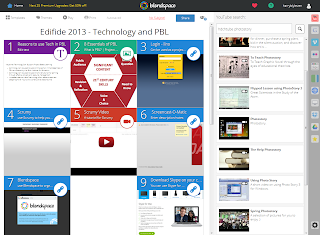
For the videos, I have been attempting to find out what tools and resources to include in the videos and which ones to not include.  I am trying to find resources that can be used by both the teacher and the student.  I am also trying to include resources that have multiple uses and tie into several of the 8 Essentials of PBL.  My favourite online tool right now has to be Blendspace.  Here is an example of a Blendspace that I have made for a workshop I will be giving on "Using Technology to Support PBL" at the Edifide Teachers Convention in a couple of days. Blendspace helps the teacher to manage the information and resources that students will need as they work on a project.  With its grid set-up, Blendspace organizes the online learning space.  To create a Blendspace the owner of the space quickly and easily drags and drops in resources from YouTube, Google, Vimeo, Flickr, EduCreations, Dropbox, Google Drive, bookmarks for links, or they can upload their own resources and multimedia files.  For the student, Blendspace can help them organize the videos, websites and resources that they are working on - it can be a digital notebook.  Blendspace can also be used as a digital portfolio tool allowing students to post their findings, creations and it can be easily shared with others.


While I am currently working at completing both the written portion of my Masters Portfolio and the video tutorials, I am finding that the two components really drive each other.  The theory aspect of having a rationale for using technology provides a necessary grounding that the foundation of the practical videos need.  

I am currently in the Revision and Reflection stage of my portfolio.  I must admit that it feels great to be able to say that because if you look at the 8 Essentials of PBL, as modeled by the Buck Institute for Education, in the following diagram, then you can see I am on the home stretch.  One of the challenges that I have recently experienced in my work is that I am looking at each essential separately rather than looking at all of the essentials as a collective process. This has put up some temporary roadblocks for me as I cannot see this topic ever being completed - which has been a really big struggle for me! It is my hope that in the next 3-5 weeks that I can complete my work - even though this area of work will likely never be finished due to its ever changing nature.  

Wednesday, September 11, 2013

A Boy, Constructivism and LEGO!

I have just finish a section of my final project for my M. Ed. degree.  My overall topic is the implementation of technology into a Project Based Learning. The section I am currently working on is about Constructivism. My research is pointing to how teachers who incorporate technology into their teaching practices generally become more constructivist in their pedagogy choice and delivery.  This often leads to teachers adopting an Inquiry Based Learning strategy.  In the school where I currently teach, Hamilton District Christian High, we have been implementing and using  Project Based Learning.

I like this simple definition of Constructivism from Wikipedia:

Constructivism, as a perspective in education, explains how knowledge is constructed in the human being when information comes into contact with existing knowledge that had been developed by experiences. 

As a teacher becomes more familiar with technology and begins to use it more for their own learning, the next step is to ask the same of your students.  The role then is to help students on their journey of learning by providing a safe learning environment, access to resources and a structured environment in which they can learn.

Now permit me a little brag moment about my son who is just entering grade 4.  Like many kids, school is sometimes fun, sometimes awesome and sometimes boring.  So far the start to this school year has been on the sometimes fun side.  
He needs a reason to learn - he wants to know "why this is important". He also loves LEGO - well really, who doesn't?  He normally gets a new set, builds it, plays with it for a while and then just has it for display on a shelf in his room, our family room, our dining room and our living room. 

Recently he has also developed an interest in super hero movies.  He was a bit disappointed to discover that he would not receive every super hero LEGO set just so he could have the characters to play with. He also realized that he had lots of parts from various LEGO characters of sets that he did not wish to keep.  It become his project to construct his own set of custom LEGO Super Heroes.  He did not just want to make random Super Heroes - he wanted to make his "customs" look as close to the real characters as possible.  It is amazing how much research that he did in order to create his "customs".  He would often just grab the iPad, find images (front and back) and YouTube videos of the authentic character, get his Sharpies, and model paint and start customizing his characters.  Throughout the process he would ask for feedback, not just to receive praise but also to make his characters better.  When he would run stuck on an aspect he would consult the experts - more YouTube videos, his LEGO books, his mom (a talented and precise artist) and his Papa (a talented and precise doll house builder with a big paint selection).  

Each character could take a couple of hours or even days as he patiently waited for paint to dry and the next coat or accessory to be placed. Not every first edition was exactly as planned. He would revise or "do over" until he was happy with the product.  Once a character was complete he would again grab the iPad and create a video about the character and the process necessary to make it.  We haven't uploaded the videos yet, he wants to wait until he is all finished but he has allowed me to snap a couple of pictures.


What has been amazing for me, as a father and teacher, to see is that there was a purpose that was driving the learning and that my son was able to learn from drawing on his past experiences, research how to make and create his "customs" and be able to share his results (soon) with others.

Having seen all of this unfold in the last couple of weeks fuels the fire for me to continue to ensure that my students also have a reason to learn. I want to provide them with authentic learning experiences in which they too can construct and shape their learning.

Saturday, August 10, 2013

Overwhelmed, but going in the right direction.

The research stage of a project can be overwhelming.  I will admit that this is the case for me as I am working on the written piece for my Master Portfolio.  The really hard part is just telling myself to start the writing process.
http://scriptcat.files.wordpress.com/2012/03/research1.jpg
I have thoroughly enjoyed finding, reading and taking notes from the many chapters, articles, blogs etc that I have read about Project Based Learning and technology.  As I work towards developing a solid rationale for using tech in PBL, I am also thinking about which technologies and tools that I wish to highlight via video tutorials.  As I move along and develop the rationale and the 4 key points that I will be focusing on (see previous post) I was reminded of the need to organize, synthesize and catalogue my findings thus far.  Just the process of organizing and grouping my findings has really helped to ease the "overwhelming" feeling and knot in my stomach about "getting going" with the writing process.  I like to run (an ankle injury has recently slowed me down, however).
In the winter I run on a treadmill and watch movies on my laptop to pass the time. Last winter, I watched Finding Forrester.
http://haingu.files.wordpress.com/2011/02/r__findingforrester4.jpg
 
The movie is about an author mentoring a teenager who is a gifted writer.  One of my favourite quotes from the movie is "No thinking - that comes later. You must write your first draft with your heart. You rewrite with your head. The first key to writing is... to write, not to think!"
This quote is now reminding me to just get in there and write and to run with it!

Friday, July 19, 2013

Key Reasons to use Tech in PBL


During the last couple of days, I have been doing a lot of reading about Project Based Learning (PBL) and technology. Specifically, I have been reading how technology can and needs to be used to support learning in a PBL model.  The readings do not out-rightly say that PBL needs technology but that using technology to support PBL is needed. As I work on the final project for completing my Master of Education degree, I am attempting to develop a rationale for using technology in PBL.
I currently am leaning towards a number of key reasons for using technology in PBL. One of the fun things about researching is that you start to read a number of articles, blogs, wikis, tweets and posts that provide you with new and unexpected ideas.  The last part of the rationale for why technology should be used in PBL suggests that much teacher growth, professional development and teacher leadership can be fostered and developed in teachers that incorporate technology into their PBL teaching.  While the particulars and supporting research are not yet included, it is these key reasons below that I am currently working with as to why technology should be included in PBL.

Key Reasons for using Technology in PBL

  • while PBL does not need technology per se, technology can support the learner and the learning process.  I believe that each of the Eight Essentials of PBL can and should be supported by technology. One of the products that I will be creating and sharing as part of my Master's project is a series of video tutorials showcasing technology for each of the Essentials with goals of providing educators and learners with tools that permit them to dig deeper into their learning
  • technology allows for effective planning and management of learning projects. Managing projects, getting student feedback and reflections, and providing students a voice and choice is believed to be readily completed through the use of technology and online tools
  • as teachers learn, and in turn use, more technology in their teaching, their teaching often becomes more constructivist in nature - this should lead to better PBL
  • technology supports Growing Success.
    Growing Success is an Assessment and Evaluation Document for the province of Ontario (Canada). The document empowers teachers with much freedom in terms of assessment tools, collections of information (including conversations and observations) and evaluating students. An important part of Growing Success is Assessment for Learning, Assessment as Learning and Assessment of Learning
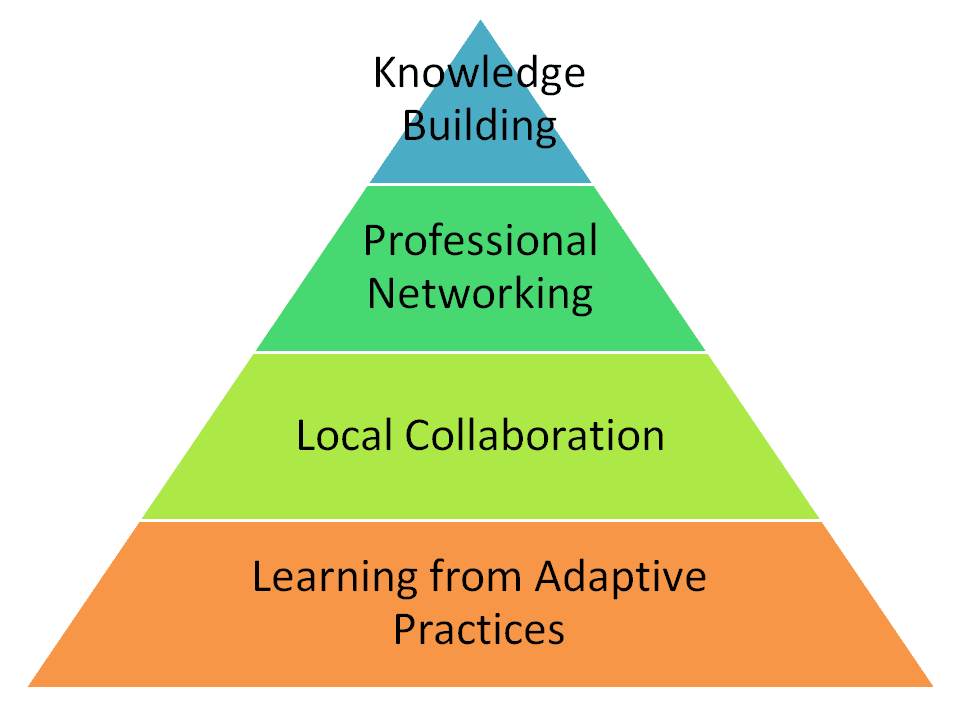
  • using technology in PBL can foster professional growth, professional development and leadership among teachers. Riel and Becker discuss the idea of Teacher Leadership Practices and present their model (pyramid).  This model also is similar to the SAMR model for "Empowering Students with Technology" 

  • Some other important points that I am considering are how technology is supported in my school, how the ISTE Standards can be brought into the PBL - most likely in the 21st Century Learning skills, and the actual density of technology available for learning in our school.

    My steps in the next couple of days are to look more at PBL for 21st Century Success. This book, by Suzie Boss of the BIE, focuses on how the skills of; Critical Thinking, Collaboration, Communication and Creativity are taught, assessed and evaluated in a PBL setting.  My readings are leading towards  technology also playing a key role in this.

Tuesday, July 16, 2013

Project Based Learning and Technology

It has been a long time since I last posted - a little over a year.  My last post was about optimism for the 2012 Blue Jays season.  If you follow baseball the Jays still aren't giving much reason to be optimistic as a fan.

I am getting back into my blog again for a couple of reasons:

  • it seems like the right thing to do again
  • I intend to use this blog to record my reflections and my journey as I dive into completing my Masters of Education Portfolio through Lakehead University about Project Based Learning and how technology can support the learning
  • I was also inspired by many great people and educators as I attended PBLWorld in June who blog on a regular basis. - for a summary of the Coaching Academy that I attended at the conference please visit the blog of Bianca Hewes who is an avid blogger, and PBL leader
  • I want to use this blog as a platform to get my thoughts and the resources that I gather organized and consolidated in one spot
Over the next several months, I will be working at answering the following Driving Question;

How can I use literature and PLNs to develop a rationale and provide examples for educators to incorporate technology into PBL?

If you wish to read my full proposal it can be found here.

My hope is to develop a sound rationale for using technology to support Project Based Learning as well as to provide video tutorials of specific technologies that support PBL - like a how-to video. The Buck Institute for Education has an well respected and robust model of PBL and it is their model that I will be using as I continue my work.  For more info on their model please visit http://www.bie.org/about/what_is_pbl/ .

The BIE does provide an info-graphic of their model which outlines their 8 Essentials of PBL. The video tutorials that I create will be related to these 8 Essentials.  

I am beginning to dive into some of the readings to help develop the rationale. Here are a couple of the articles that I currently thinking about.
The next steps for me are to continue on in my readings and researching how technology supports learning and specifically Project Based Learning.  I will also be developing a rubric/metric to help find appropriate technology that educators and students can use in their projects. 

I will be using my Personal Learning Network (PLN) of learners and educators to bounce ideas off of and to solicit opinions, ideas and resources.  If you are reading this then I hope that you might also take the opportunity to become of my PLN. This is most easily done by commenting on this blog or by following me on twitter @hblyleven


Friday, April 20, 2012

Batter up!


I enjoy baseball.  I was able to see the Blue Jay's home opener recently with some great friends.  I even had the fortune to be interviewed on City TV. 
My dad's cousin, at least to the best of our knowledge that is the relationship, is a Baseball Hall of Famer.  Bert Blyleven was a major league pitcher for a few teams and he was a member of the World Series Pirates (1979) and Twins (1987). His best pitch was the curveball.  Many baseball analysts will still compare others pitchers' curveball to Bert's.  If you have ever played baseball, fastball, or slow pitch, it is always amazing to see how the baseball can move and quickly change direction.  I had the chance to pitch a little bit when I played fastball.  My best pitch was also a curveball.  Sometimes I could really confuse a batter by starting the pitch outside and moving it in or in the middle and then outside.  As a batter, I too was often fooled when thrown a curve.

Every once in while life throws us the occasional curveball.  Sometimes we have plans but our plans don't always work out the way that we had hoped for various reasons.  I guess I think that God likes a good baseball game.  I say this knowing that God has a plan for all of us.  These "curveballs" that we try to swing at are usually the things that we wish to do and God, sometimes with a slight curve or sometimes with a big swooping curve, reminds us of His plans for us.  I am reminded and often humbled by Jeremiah 29:11.


If you recall from my very first blog post I mentioned that I would be trying blogging and tweeting on a regular basis.  My curveball, or obstacle, I believe was that of time.  It is not that I did not have the time, however, it was how I was using my time.  I think it is important that I keep maintaining my blog.  I have just finished a very busy past three months - I have wrapped up some teaching at Redeemer and just this week finished a course that I was taking.  Each of these activities threw some curveballs at me.

In the Comm Tech class, it was the hope to have the students blog weekly as part of their presentations  of learning and reflection.  I can honestly say that it did not work as initially hoped.  Some of the class is still blogging, while others, are coming up with other ways to demonstrate and share their learning, one in which they have more say and were able to choose what they think will be an effective communication piece.  I will fill you in on this in a later post.  This was definitely a curveball for me as, in my mind, the student blogs were going to be awesome but to my benchmark and not theirs.  I am glad to say that the blogs and portfolios are still awesome and taking a different shape then what I had initially planned.

I look forward to see many of you this week at Parent Teacher Interviews where we can share more and have a chance to chat.

E-waste Collection - remember to bring in your electronic waste to Parent Teacher Interviews or drop by with it on Saturday, between 10am and 3pm as the grade 9 class collects electronic waste as part of a project.  There is a free BBQ starting at 11am!

Grade 9 Computers - BTT 1O
Report came out last week.  You may have had a chance to read the report and notice that there are not a lot of changes to it.  What are we doing?  The class has been busy of the last number of weeks as they work on their e-waste project.  We are just about finished our in class time for the projects.  I continue to be impressed with the ideas, planning and implementation of many of the group projects.  I, as well as the students, look forward to seeing this being completed and presenting our finished projects.  Mr. Brink and I are also using this course to help out with some of the foundational and fundamental elements of school.  The class has also been busy working on a research report about topics in online security and personal privacy.  These reports are also wrapping up this week.  The next step for the reports is helping the students develop these reports into presentation for the class.

Grade 10 Communication Technology


This continues to be an exciting course.  The class has been busy creating posters for the upcoming play, shooting and editing videos, creating podcasts and brushing up on their graphic design skills.  

Friday, March 23, 2012

Keeping it real!

I have mentioned previously about a course that I am currently taking.  The course delivery method is "on-line synchronous", this means that at a set time I meet on-line with my other classmates, who are in various parts of the world.  While this method of learning is new for me and I am enjoying the process, the title of this post, Keeping it real, it something that I am struggling with in this online context.  I have classmates, and we talk, however, I have only ever met one of them and that was at Technology and Education conference this past Fall.  So the classmates are real and our interactions are real but it just doesn't always seem real.  I miss getting to know my classmates and having conversations with them that are not necessarily course related - I feel that I am missing out a little bit on the community of a class.  I wish that I could really get to know the people with who I am working. I fully understand that on-line communities are very real, but I question if I am able to give all of the various communities, of which I am a part of, the real me?

I am thankful that HDCH is a great community and that each class is its own smaller community. Being intentional about "keeping it real" is a challenge that I, and maybe some of you, struggle with as our use of social networking and our on-line communities continue to grow. The great part is that we are called to be a community, God has created us to be communities of believers.  As the word community continues to have new and various examples, it is encouraging, and reassuring, that God is present in all of our communities.

Grade 9 Computers - BTT1O
Hold on to your e-waste! The grade 9 classes are well into their electronic waste projects.  There are many incredible projects taking place.  Mr. Brink and I have challenged the classes to not only understand what electronic waste is, but to really do something about it.  There are many different ideas like; videos being made to foster an understanding of e-waste, a song that will tell people about e-waste through music, Sunday School curriculum being made, e-waste video games, groups hoping to visit other schools and give presentations, an e-waste collection day, a children's book, Facebook pages and other ideas!  I encourage you to have a conversation with your grade 9 student and find out exactly what they are doing!
The e-waste collection at our school will be during the week of April 17th to April 21st.  Have a look at the UKnight for more details about the event.
Concurrently the grade 9 students are also researching various topics about personal information, privacy and security in a digital age.  This activity has students researching, formal writing reports and then taking their findings and presenting them to their classmates.  We are hoping to video the presentations.  I will try to post some of videos here when they are complete.

Grade 10 Communication Technology
For the last two weeks the Comm Tech class has been working are developing and refining their video editing.  Some the videos involved stop animation, constructing a reality from a different perspective, reversing video and other techniques. The class is just beginning their second module.  I will keep you posted and provide samples of their work!

Monday, February 20, 2012

Welcome to Second Semester

Hi again everyone!

It has been a several weeks since my last post.  I must admit that I have been rather busy but I have indeed missed the opportunity to write and communicate with you.  For the parents that are new to this blog, the parents of the students in Communication Technology, welcome you to your first view of Taking Tech' in HD!  For the parents of my last semester students, or anyone for that matter, if you wish to be removed from the mailing list for the blog please just send me an email (hblyleven@hdch.org) and let me know that you wish to no longer receive the blog updates.  I will not take it personally  ;)

http://somenovelideas.typepad.com
Some of you may recall that I instruct a class at Redeemer, Technology in the Classroom.  This class usually is offered in January and February with two sessions per week. Over the last 14 years, I always enjoy teaching this course.  What I like the most is sharing teaching ideas with other educators and other soon to be educators.  This year, I had my students blog as part of an assignment.  For some this was an activity that met with some uneasiness, while others enjoyed the process.  Some people think that they have nothing to write about or that no one will care what they have to say.  My purpose for having them blog is be transparent with their ideas about teaching and also to begin to develop a Personal Learning Network (PLN) in which they can converse and respond to other educators.

The idea of belonging to a PLN, I think, is modelled very well by our students.  Most kids, especially those with cell phones, are constantly in connection with their network and freely call on "their network" for almost anything, including learning.  Aside from the "what u doing?" and the "where r u?" texts, I think that the amount of "local knowledge" and information shared by our students is quite vast.  However, I do believe that our students need some guidance about how to effectively use technology.  Recently, on the local news, there was a segment about how some high school students were making poor choices about how they used technology within their network and that the community was hurting as a result. The news reporter broke a story about how popular "sexting" was at this school. "Sexting is the slang term for the use of a cell phone or other similar electronic device to distribute pictures or video of sexually explicit images. It can also refer to text messages of a sexually-charged nature." (http://teenhealth.about.com)

Throughout our computer and technology courses at HDCH, we attempt to show students, not only the incredible things that we can do with technology but we also try to be open and frank about some of the dangers and lures of technology.  This current generation, Generation Z, which is;

  • born after 1990
  • highly connected
  • carrying mobile technology
  • readily sharing information online (often without thinking about future ramifications)
and has the tools, and the knowledge to work very well.  Making good choices, I believe, is a skill that needs to be discussed and practised.  I always enjoy the  impromptu class discussions about appropriate technology use, usually after a cellphone goes off in class. I would also enjoy hearing from you, the parents, about ideas and topics you would like to see included in the planned class discussions.  I invite you to please leave comments below or email me at the school. 

Grade 9 Computer Class
The grade 9's have been busy as of late. Looking at effective webpage design provided students a foundation to begin with, as they created their own websites using Google Sites.  Currently, the class is just about to wrap up a mini unit on Power Point. Using Power Point in a new and interactive way was our focus.  Using Power Point, the class created a five question multiple choice quiz on electronic waste.  This week we will be looking at having some fun with Power Point and create some interactive video games.  I will try to post videos of the games for the next blog.  
The E-waste quiz also allowed Mr. Brink and I to have the students think again about the topic which will be our main project for the next semester.  We look forward to having our students wrestle with a topic that can have such a negative affect on God's creation.  We will keep you posted.

Grade 10 Communication Technology
It is my pleasure to again have the opportunity to teach this course.  For me, this is one of the most exciting courses that our school has to offer.  This semester, the class in divided into four Project Based Modules in which students, and/or groups of students, take the skills that this class provides and uses them to develop tangible productions that others need, i.e. logos, graphic design work, audio productions, video productions etc.  
Below is a group's first production.


If you are not sure what this course is all about then have a look at the picture below. It represents the thoughts, ideas and words that this class determined were important.  We liked it so much that it is now a poster hanging on our classroom wall!

Saturday, January 14, 2012

Happy New Year!

I hope you all had a good holiday season and that you were able to celebrate with friends and family. The holiday time was great for me.  It provided me a chance to relax, refocus and recharge.

http://www.ehow.com/
I am thankful for the two week break and the time I had to help me prepare for the next two busy months.

This past week I started taking a new course through the University of Ontario Institute of Technology.  It is called "web based learning tools." As it has only been one week, we have just been introduced to the topic and have been getting to know some of the other students in the course. 

My small group defined web based learning tools as:
Internet based activities that complements the curricular expectations and allow students to investigate ideas at their own pace, while assessing their understanding before moving forwards. The spectrum of optional learning activities allow the interaction of ideas outside of a classroom and facilitate the use of a wider pool of resources and learning spaces.
We will find out next week if our definition is close as we were asked to resist the urge to Google it - so far, so good!

This course has a different structure than any other course that I have taken.  The course format being used is called Synchronous Learning and there are some activities which are completed through Asynchronous Learning.  Synchronous learning has all students, 23 of us, on-line at the same time.  We all need a computer with a microphone and speakers or headset, so that we can communicate with the instructor, other students and our "breakout groups."  

I am excited by this course for a number of reasons:
  • I like meeting people. Even though it is likely that I will not meet these people face to face, I have an opportunity to engage with other people about educational topics and resources.
  • I look forward to learning about new resources for students and teachers.
  • Online learning adds an interesting component to education.  There are several different types of blended learning, ranging from traditional to completely on-line.  On line learning intrigues me with its many possibilities, and honestly, kind of scares me because of its many possibilities.
  • Learning spaces (where one learns), through the use of internet learning, are quickly becoming blurred with the rest of our "spaces"
  • I am excited by how I can help use and incorporate new thoughts, ideas and possibilities at HDCH
Over the next few months I will try to share some of the key ideas and thoughts about the learning experience and materials from this course.

This past week I also started teaching an evening class at Redeemer University College.  For many years I have been working and learning with pre-service teachers in a course called Computers in the Classroom.  The title of the course is a little misleading as we spend much of our time looking at technology and its impact in the classroom upon; teacher-student relationships, learning, and some of the concerns in education.  As a class we have great discussions and discover many resources.  It is exciting to see and hear the energy and enthusiasm that new teachers bring to teaching and learning.  We may not know what our schools might look like in the next 10 years, but, we can feel confident that we will continue to be blessed with good educators!

ICS3U - Grade 11 computers
The grade 11 computer class has been working on summative assignments since they have returned from the break.  There are many great ideas for programs that the students are working on such as; word guessing games, fuel consumption and efficiency, connect-four, various text based word games and other ideas.  View a more complete description of the summative assignment.  The summative assignment, while challenging, allows the students to challenge themselves in their programming ability.  Students also have indicated what assessment level that they hope to achieve.  

BTT1O - Grade 9 computers
The past week has been exciting for me in this course.  The students have been researching and defending various topics through debates that we have had in class.  The topics have been about copyright laws in a digital world, the purpose and use of cell phones in schools and education, and the pros and cons of each student at HDCH having a netbook or tablet device.  Students have also responded to various articles about each topic. Here are the articles that they have responded to:
If you have any thoughts on the post or the articles listed, as always, your comments are most welcome!


Monday, December 19, 2011

And to all a good night!

My family had its first Christmas celebration this weekend.  I will see more of my extended family later in the month and, unfortunately, because of distance, there are some family members who I will not see this holiday season.  And of course there is my mom who gets to celebrate Christmas in heaven - that must be quite the celebration!

I, like many others, really miss my family over the holidays.  I get rather nostalgic and think about Christmases past and how we would finish our chores early on Christmas eve, go to church, open gifts, enjoy lots of food and lots of time to just be together.  There were many games, lots of play and time to praise the Lord in our house.

 I know that there are lots of ways that technology still allows us to stay connected and, yes, we could and we have, opened presents together even though we are over 3000 km apart but it isn't the same as actually being there.  A visual hug on the computer can't possibly match a real hug from my nephews and nieces, or my brothers and sisters.  

Technology, in all of the ways that I use it, I believe, still falls quite short in being able to truly stay connected. 

One of the best things I like about teaching is the ability to connect with students and colleagues.  Being able to see my classes, on a regular basis, really helps me to find purpose, because lets be honest, how many of us truly remember the lessons that we had in school.  There may be a couple of key lessons or topics in high school that you remember, for good or for bad, but it is more likely that you remember the people of your schooling experience.  There is much talk of online learning, which I support, but I will reserve that topic for another day! In a similar manner, how many of use remember the presents that we received as kids?  There might be a few gifts that have stayed in the archives of our mind or that we remember through the assistance of pictures, however, we can likely recall the experiences, the events and the people more readily. It is these interactions that stay with us!  

This Christmas season I hope you all have a chance to enjoy time spent with family and friends in celebration!

Grade 9 Computers - BTT 1O
The grade 9 class continues to work through a series of tutorials as we discover how to edit digital pictures in Paint.net.  It has been fun and enjoyable to listen to the students when they have their "aha" moments.  It is also exciting to see certain students become the "goto" person as they discover new things and share and learn from each other. One of the tutorials the students have been able to do, starts with a picture of dried mud and ends with an exploding planet.  

Grade 11 Computers - ICS 3U
In this class we are finishing our assignments for Chapter 7 in Java programming.  This is the chapter for which I have create video tutorial examples for the different types of methods used in Java.  These tutorials can be found on our school YouTube site http://www.youtube.com/user/HDCHtube.  Later this week we will begin chapter 10 and introduce our final summative project which we will start when school commences again in January.

Monday, December 12, 2011

Fit to be tied!!!

I love the month of December, I love Advent and I love Christmas!  There is a special excitement in my house, my church and our classrooms.  The month of December also provides me an opportunity to wear my Christmas ties!  Yes, the picture below is my Christmas tie collection.  I have accumulated this collection over the years.  Some ties are from my father-in-law, my wife, Value Village, and garage sales.  Strangely, I have never received a Christmas tie as a "teacher present" - I guess my students think that I have enough.  I actually have more than enough ties, 20 to be exact,  to be able to wear a different one each teaching day of December.  In fact, I may start wearing them in November next year!  This tradition that I have, appears to be appreciated by the students, as many make an extra effort to talk to me so they can check out the tie or compliment the tie.  November and December are busy months and I enjoy how my ties lift my spirit and hopefully those of others.


I say that these are busy months, yet, I must confess that this year these months have probably been the easiest in all of my teaching career.  This is due totally to the great work that Mr. Wensink did in our classes.  Mr. Wensink has now finished his teaching placement here at HD and is able to enjoy a well deserved break.  Mr. Wensink is a natural in a classroom. His gentleness, respect, presence, patience, professionalism and commitment to the Lord and his students will serve him well.
He did such a good job that, at times, the students were wondering who I am and why was I there.  God bless you Mr. Wensink!!!

A topic in education that is dear to me lately is "the flip." The flip involves flipping the classroom so that lessons are completed as homework, usually via video on YouTube, and class time is used for students to do their work, experiment, ask questions, complete assignments etc.  I have just started using the flip and providing online tutorials for my grade 11 computer students.

I will be curious to see how well accepted the tutorials and lessons are by the students.  This format of instruction makes sense as it allows me to be more available when students will likely have questions and/or need assistance.  I will keep you informed about the progress being made!

Grade 9 Computers - BTT 1O
We have recently begun our graphic design unit.  We use an Open Source, and free, program called Paint.net to manipulate and create images.  Our first task was to create Ipod advertisements. The first picture was taken in front of a green screen that we then removed and replaced to get the new image.  It was quite exciting and, in a short time, students produced a rather polished advertisement.  We will continue to work with graphic design until the Christmas break.  If there are any graphic designers or graphic artists out there, I would enjoy talking to you about possibly being a guest in our class!

Grade 11 - Computer Programming - ICS 3U
We have just finished our presentations about computer issues and have had a chance to watch some of them.  It was interesting how we learned from the videos about how to present and also how to take better videos.  This week we are starting a new unit on methods in Java programming.  This is the chapter that I will be making video tutorials for so keep checking out http://www.youtube.com/user/HDCHtube to see the updates!

Sunday, December 4, 2011

Check in time!

Whenever I stay in a hotel I am often surprised at the time that the hotel provides for a check in time, often 3pm - this is much later than I would like.  When I go somewhere with my family, the hotel part of the trip is a big part of the experience, especially if there is a pool, water slide, video games or for myself a treadmill.  I guess I want to get the most out of the experience and value for my dollar.

Often when I teach, lead workshops or help people to use technology, I will provide quick little opportunities to "check in".  These "check ins" occur quite regularly, and the feedback which they provide, is valuable in the classroom.  As new skills or processes are being taught and learned , these "check ins" give me great information about how the group is doing.  My favourite line in the classroom is, "Check how your neighbour is doing."  This short line allows students to not only help others but also to see if they too are on the right track.  It also gives me a moment to walk around the room, provide help as needed, and ensure that everyone is one task. 

This post is my "check in" time for the last month and bit of blogging and tweeting.  I must admit that I am tweeting less frequently but my tweets, I believe, have more substance to them. I had hoped to tweet 5-10 times per day, which on some days is easy and on others it is more difficult.  Also,  I am occasionally finding my blog as a duty that I must do, yet it still produces lots of enjoyment and from stats and feedback, the blog is well received - thanks!

In my first blog post I mentioned that I would assess my blogging and tweeting after my "trial period".  I will provide a simple SWOT (Strengths, Weaknesses, Opportunities, and Threats) analysis - my first year BUS 121 at Redeemer is still proving its worth.

Strengths
  • allows me to continually think about how I use technology
  • through following others I have read way more about technology in the last 6 weeks than I would normally do
  • I am beginning to follow and connect with other Christian Educators - some that I already know and some that I have only met "virtually"
  • more communication with parents and guardians - ( I would still appreciate more comments on the blog please!)
  • I am able to share with other educators and I am seeing more benefits to collaboration than I have in the past
  • wow! There are some incredibly gifted people out there!
Weaknesses
  • there is little face to face communication
  • 140 characters is not a lot to say something meaningful
  • little snips of information can easily be taken out of context
  • information overload 
  • fear of missing something that someone tweeted and is 200 tweets down the list
Opportunities
  • there is great potential for Christian educators to share knowledge and ideas
  • there is great potential to connect and partner with all educators and experts
  • blogging provides a chance to have dialog with parents on a more regular basis ( I would still appreciate more comments on the blog please!)
  • able to "bring" others into my classroom who can shed more light on the topic
  • Life long learning on my part
  • model effective uses of technology in education
Threats
  • information overload
  • finding the time to tweet and blog
  • ignoring other concerns
  • getting side tracked and off topic
  • not wanting to miss a post or tweet
  • being "consumed" by the processes
If any of you blog, podcast, tweet etc and wish to share some of your own SWOT analysis please comment below.  
Overall, the process has been amazing.  I am really enjoying the opportunity to get my thoughts down and connect with a community.  I am learning much and, therefore, I will keep blogging and tweeting.  Please bear with me as I still learn to communicate effectively through a blog.

You can expect another "check in" around the time of the semester switch.

Grade 9 Computers - BTT
The class is just about ready to wrap up their video editing with Mr. Brink.  The filming process has gone well and I believe that we have some Oscar worthy candidates!  Mr. Wensink and I will have our regular class back on either Tuesday or Wednesday.  Sadly, Mr. Wensink has only one week left with us.  It has been a pleasure having him in our classroom.  He has fully assumed the role as the class teacher and the kids have fully accepted him.  I will likely be thought of as the substitute when he finishes and I take over again.   

Grade 11 Computer programming - ICS 3U
Mr. Wensink has done a great job with this class.  The students have finished working on programming a guessing number game.  Mr. Wensink provides great feedback, encouragement and appropriately challenges all students to work at, and beyond, their capabilities. Through several class discussion about issues with, and of,  technology, Mr. Wensink has been covertly prepping students to critically evaluate tech, and now, the students are working on their own technology topics.
We look forward to students presentations of learning this week.  Last week our school took part in a day of silence to honour Uganda, and especially young girls who may not receive an opportunity for education.  Some students demonstrated support through a vow of silence on the same day that Mr. Wensink had planned a class discussion.  To honour the day, the class took to the Internet and had a real time discussion using todaysmeet.com.  This was a great way to model the use of technology and in so doing, our whole class had a vow of silence for about 20mins.

A blessed Advent to everyone! 

Friday, November 25, 2011

If I could put time in a bottle

Welcome to "Talking Tech' in HD"!!! That is the new title of my blog. Thanks to those who took the time to vote!  In the future look for the chance to vote on a logo.

The title of this week's blog is also the title of a Jim Croce song - please watch the video below.
 Jim Croce is one of my favorite music artists. He is before my time - honest - but the title is perfect for what I wish to write about this week. The chorus starts with the following lines:

But there never seems to be enough time
To do the things you want to do once you find them


This has been an incredibly busy week here at HD, and especially for the staff as we have parent teacher interviews. I enjoy the 8 minute block that I get to spend with the parents as we discuss and work out strategies, talk about the course, talk about the "whole student" and depending on how well we know each other - just time to catch up. This is time well spent and is very valuable to me, the teacher, and I hope it is as valuable to the parents, the students, the school, my classes and the community. The time spent together provides me much feedback, thought, motivation, and blessings, therefore, it is time well spent.

In the last post I mentioned how our grade 11 class helped the office arrive at the schoolbookings.net solution to streamline the process of signing up for parent-teacher-interviews. The old method of scheduling consumed approx 40 hours, each term, from the office staff! While the old process had the same end result, it was not time well spent. The gifts and talents of our office staff could be and now are better put to use.
It was fun to see a smile on Mrs. Pot's face as we discussed scheduling PTIs, the smile was mostly because it is now so much easier and not a frustrating or time consuming task.

With the correct technology, we can be more efficient and give honor and value to the time of others.
I sometimes struggle with the balance of time and technology, and how it is not just my time but also my family's time. One of my struggles is how much time I spend using technology and how long I spend on one task. I enjoy working with technology and computers, and for me it is also a hobby and quite fun but I need to balance it.

If you have been following from the start, then you know that I am using Twitter (@hblyleven) to learn of it and learn from it. I have really benefitted from the thoughts of others as we share ideas and information. It, like this blog, has taken time but I think these activities are important, but I am making every effort to make sure that these do not take time away from important things like my family, my church, my friends and our community. To balance out the equation I need to give things up - I am watching way less tv - probably a good thing! I think that these activities are time well spent!

My challenge for you, for the next week, is to be conscious of your time spent using technology and that it is indeed time well spent!

Grade 9 Computers BTT1O
We are currently on a "rotation" with our class and Mr. Brink's class.  The rotation allows the students to discover and learn about movie making with Mr. Brink.  Mr. Brink is the other BTT teacher and is also one of the HD media teachers. His expertise in this area is much appreciated.  As a result, Mr. Wensink has made the move to Mr. Brink's class and is working through spreadsheets with them.  Mr. Wensink is already two thirds of the way through his 6 week placement.  I am very grateful and impressed with the work that Mr. Wensink is putting into our classes.

Grade 11 Computer Programming ICS 3U
The students are creating a guessing number game in which they are incorporating all of their newly acquired programming skills.  Mr. Wensink is also incorporating and engaging students with discussions about computer and technology issues such as; online censorship and how the Occupy Toronto demonstration is being supported by a hacking group called Anonymous .  Below is a clip of the message that anonymous delivered to the Toronto government.